


La IA no es un autor
Cada vez con más frecuencia, me encuentro tratando de explicarle a alguien que si algo "lo dijo la IA", en realidad no lo dijo nadie. La IA no es un autor, es nada más que software. Así que encontré un atajo amable (ponéle) pero claro para tratar de explicar.
More and more often, I find myself trying to explain that if something is "said by the AI", in fact no one said it. AI is not an author; it's only software. So I found a friendly but clear shortcut for my explanation.
Dejá de citar a la IA
Fue cuando me crucé con el sitio stopcitingai.com, de Leo Herzog. Me pareció una explicación breve pero clara de que la IA no es un alguien, sino una fórmula matemática. Muy sofisticada, claro está, pero no es más que eso: así como π×r2 nos permitía calcular la superficie del círculo, los LLM como ChatGPT o Gemini nos permiten calcular qué palabra es más probable que venga a continuación.
Así como sabemos que alguien que dijo incipiente probablemente va a decir calvicie a continuación, la IA puede, aplicando unos modelos estadísticos muy complejos, predecir qué palabras quedan bien cuando están juntas. Nada más que eso (y nada menos).
Como todo el mundo, estoy fascinado con las potencialidades que se abren con el avance de la IA en estos últimos años, pero me preocupa un poco que no entendamos para qué cosas son buenas las IA (y van a ser cada vez mejores) y para qué cosas no.
Así que le mandé a Leo Herzog un PR, una colaboración a su proyecto, con la traducción al castellano de su genial explicación. El autor tuvo la amabilidad de incorporar este aporte al proyecto, así que ahora podemos mandarle la versión traducida a quien se ponga a citar a una IA como si fuera un autor prestigioso.
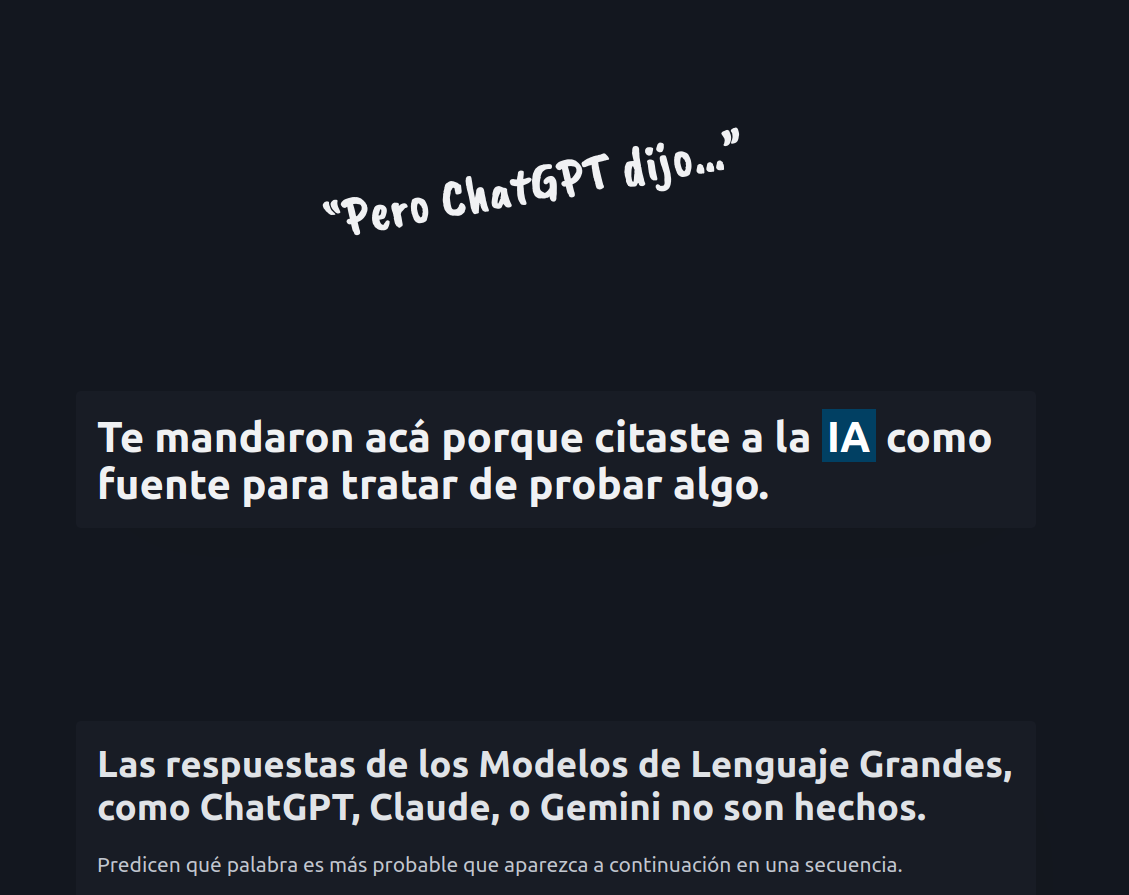
Stop citing IA
It was when I came across the site stopcitingai.com, by Leo Herzog. It's a brief but clear explanation that AI is not a person, but a mathematical formula. Very sophisticated, of course, but nothing more than that: just as π×r2 yields the area of the circle, LLMs like ChatGPT or Gemini give us which word is more likely to come next.
Us humans are really predictable when we speak. Many times we're listening or reading a sentence and we really know how it is going to end. AI, applying very complex statistical models, can predict which words fit well when they are together. Nothing more than that (and nothing less).
Like everyone else, I am fascinated by the possibilities AI has brought to the table in recent years, but I am a bit worried that we do not understand what things AI is good for (and it will get better and better) and for what things it is not good at all.
So I sent Leo Herzog a PR, which is a collaboration to his project, with the Spanish translation of his brilliant explanation. The author was kind to incorporate this contribution into the project, so now we can send the translated version to anyone who starts citing an AI as if it were a prestigious author.
Tags: articulos, castellano, english, herramientas, ia, tools, traducciones


